The Core Architecture
One elegant stack, engineered around hardware that already flies — designed to spin, to dock, and to be reused at every step.
Five ships. One hub. Built to spin.
1.1 — The ShipOAKHEART is built from exactly five reusable ships nose-docked to a reinforced central hub. The entire complex is designed to spin, providing continuous artificial gravity during transit.
The hub carries the primary propulsion system: nuclear thermal for Mars transfers, methalox for lunar transfers. The ships themselves stay pure — habitat and payload only.
- Ships
- 5 × reusable
- Central structure
- 1 × reinforced hub
- Docking
- Nose-to-hub berth
- Gravity
- Continuous spin
- Mars propulsion
- Nuclear thermal
- Lunar propulsion
- Methalox cluster
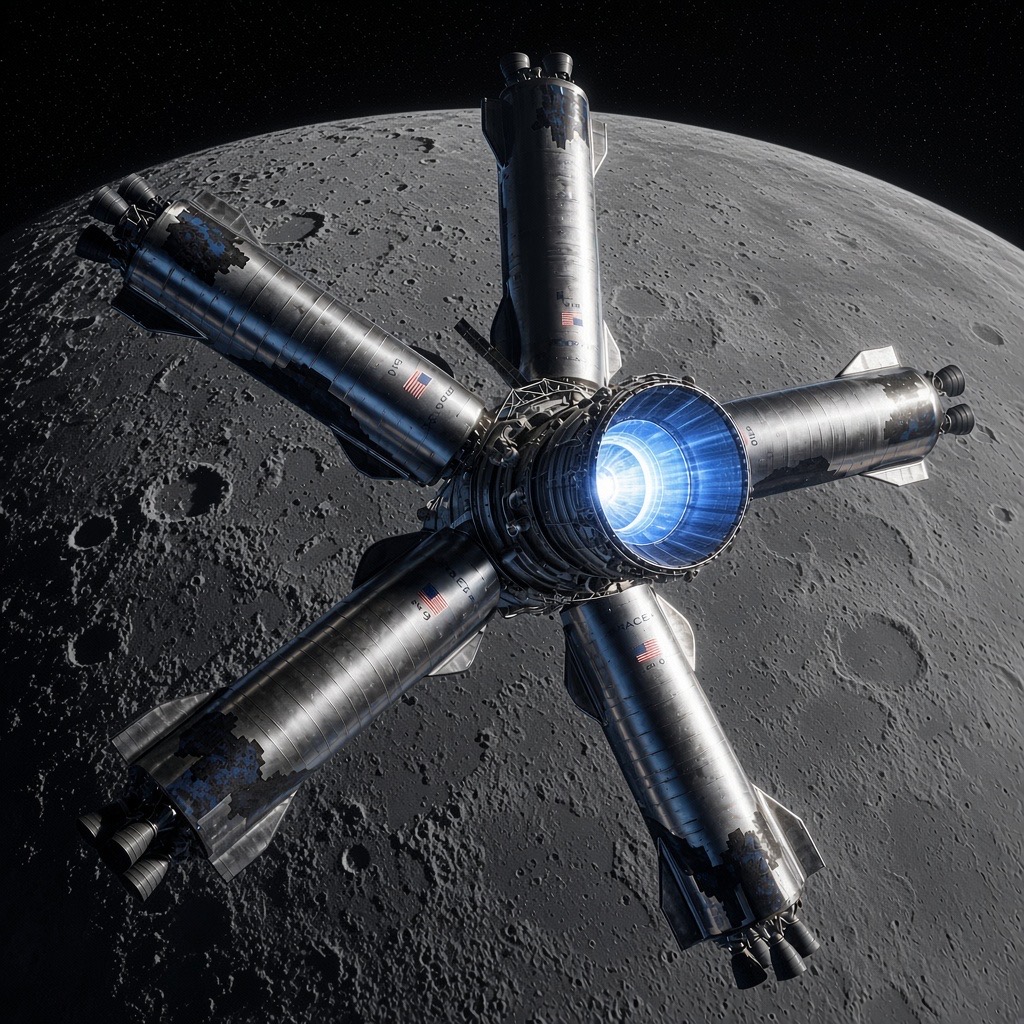
Fig. 01 — Spinning complex, plan view
Why this configuration
1.2 — RationaleNose-docking
Preserves the full landing capability of every ship — none is sacrificed to the transfer.
Permanent node
The central hub becomes a permanent orbital node at the destination, not disposable mass.
Spin gravity
Continuous artificial gravity protects crew health across long-duration missions.
Reconfigurable
The same physical stack takes on multiple roles without redesigning the ship.
Propulsion philosophy
1.3 — PropulsionSingle high-efficiency nuclear thermal engine
Methalox engine cluster
In both cases the five ships are never required to perform the interplanetary burns themselves. The hub does the work; the ships arrive with their full landing capability intact.
Crew Health & Safety
1.4 — Crew safetyContinuous spin gives the crew steady artificial gravity for the entire crossing, protecting bone density, muscle mass, and cardiovascular health on long-duration transits. Radiation exposure is managed geometrically: the reinforced hub and stored propellant sit between the crew and the Sun, and the complex orients its densest mass toward incoming particle flux to shadow the habitats. Redundancy is built into the shape itself — any single ship can undock and operate independently, so the loss of one module never compromises the others or the mission as a whole.
Six roles. One identical architecture.